In [1]:
# Сделаем файл etane.gro
#etane
#8
#    1ETH     C1    1   0.577   0.217   0.574
#    1ETH     C2    2   0.680   0.252   0.467
#    1ETH     H1    3   0.478   0.241   0.538
#    1ETH     H2    4   0.597   0.274   0.664
#    1ETH     H3    5   0.583   0.111   0.597
#    1ETH     H4    6   0.676   0.358   0.445
#    1ETH     H5    7   0.660   0.195   0.377
#    1ETH     H6    8   0.780   0.228   0.504
#   1.50000   1.50000   1.50000
In [2]:
# Построим файл топологии для этана et.top
In [ ]:
#include "/usr/share/gromacs/top/oplsaa.ff/forcefield.itp"

#[ moleculetype ]
#; Name            nrexcl
#et            3

#[ atoms ]
#;   nr  type  resnr  residue  atom   cgnr     charge       mass
#    1   opls_135      1    ETH      C1      1    -0.189      12.01
#    2   opls_135      1    ETH      C2      2    -0.155      12.01
#    3   opls_140      1    ETH      H1      3     0.0059       1.008
#    4   opls_140      1    ETH      H2      4     0.0059       1.008
#    5   opls_140      1    ETH      H3      5     0.0059       1.008
#    6   opls_140      1    ETH      H4      6     0.0056       1.008
#    7   opls_140      1    ETH      H5      7     0.0056       1.008
#    8   opls_140      1    ETH      H6      8     0.0056       1.008

#[ bonds ]
#;  ai    aj funct  b0       kb
#     1   2   1
#     1   3   1
#     1   4   1
#     1   5   1
#     2   6   1
#     2   7   1
#     2   8   1

#[ angles ]
#;  ai    aj    ak funct  phi0   kphi
#;around c1
#    3     1     4     1
#    4     1     5     1
#    3     1     5     1
#    2     1     3     1
#    2     1     4     1
#    2     1     5     1
#;around c2
#    6     2     7     1
#    7     2     8     1
#    6     2     8     1
#    1     2     6     1
#    1     2     7     1
#    1     2     8     1

#[ dihedrals ]
#;  ai    aj    ak    al funct
#    3    1     2     6      3
#    3    1     2     7      3
#    3    1     2     8      3
#    4    1     2     6      3
#    4    1     2     7      3
#    4    1     2     8      3
#    5    1     2     6      3
#    5    1     2     7      3
#    5    1     2     8      3
#[ pairs ]
#; список атомов 1-4
#;  ai    aj funct
#   3  6
#   3  7
#   3  8
#   4  6
#   4  7
#   4  8
#   5  6
#   5  7
#   5  8

#[ System ]
#; any text here
#first one
#[ molecules ]
#;Name count
# et    1
In [ ]:
#Вам даны 5 конфигурационных файлов с разными алгоритмами контроля температуры:
#be.mdp - метод Берендсена для контроля температуры.
#vr.mdp - метод "Velocity rescale" для контроля температуры.
#nh.mdp - метод Нуза-Хувера для контроля температуры.
#an.mdp - метод Андерсена для контроля температуры.
#sd.mdp - метод стохастической молекулярной динамики.
In [10]:
l = ['be', 'vr', 'nh', 'sd']
for s in l:
 !gmx grompp -maxwarn 1 -f {s}.mdp -c etane.gro -p et.top -o et_{s}.tpr
              :-) GROMACS - gmx grompp, 2022.5-Debian_2022.5_2 (-:

Executable:   /bin/gmx
Data prefix:  /usr
Working dir:  /home/students/y22/urazov.d/term8/Pr6
Command line:
  gmx grompp -maxwarn 1 -f be.mdp -c etane.gro -p et.top -o et_be.tpr

Ignoring obsolete mdp entry 'title'
Ignoring obsolete mdp entry 'cpp'
Ignoring obsolete mdp entry 'ns_type'
Replacing old mdp entry 'unconstrained-start' by 'continuation'

NOTE 1 [file be.mdp]:
  nstcomm < nstcalcenergy defeats the purpose of nstcalcenergy, consider
  setting nstcomm equal to nstcalcenergy for less overhead


WARNING 1 [file be.mdp]:
  The Berendsen thermostat does not generate the correct kinetic energy
  distribution, and should not be used for new production simulations (in
  our opinion). We would recommend the V-rescale thermostat.

Setting the LD random seed to -139038761

Generated 330891 of the 330891 non-bonded parameter combinations
Generating 1-4 interactions: fudge = 0.5

Generated 330891 of the 330891 1-4 parameter combinations

Excluding 3 bonded neighbours molecule type 'et'

NOTE 2 [file et.top, line 72]:
  System has non-zero total charge: -0.309500
  Total charge should normally be an integer. See
  http://www.gromacs.org/Documentation/Floating_Point_Arithmetic
  for discussion on how close it should be to an integer.


Analysing residue names:
There are:     1      Other residues
Analysing residues not classified as Protein/DNA/RNA/Water and splitting into groups...
Number of degrees of freedom in T-Coupling group System is 21.00

Determining Verlet buffer for a tolerance of 0.005 kJ/mol/ps at 300 K

Calculated rlist for 1x1 atom pair-list as 0.702 nm, buffer size 0.002 nm

Set rlist, assuming 4x4 atom pair-list, to 0.700 nm, buffer size 0.000 nm

Note that mdrun will redetermine rlist based on the actual pair-list setup

NOTE 3 [file be.mdp]:
  You are using a plain Coulomb cut-off, which might produce artifacts.
  You might want to consider using PME electrostatics.


This run will generate roughly 10 Mb of data

NOTE 4 [file be.mdp]:
  COM removal frequency is set to (1).
  Other settings require a global communication frequency of 10.
  Note that this will require additional global communication steps,
  which will reduce performance when using multiple ranks.
  Consider setting nstcomm to a multiple of 10.


There were 4 notes

There was 1 warning

Back Off! I just backed up et_be.tpr to ./#et_be.tpr.1#

GROMACS reminds you: "With four parameters I can fit an elephant, and with five I can make him wiggle his trunk." (John von Neumann)

              :-) GROMACS - gmx grompp, 2022.5-Debian_2022.5_2 (-:

Executable:   /bin/gmx
Data prefix:  /usr
Working dir:  /home/students/y22/urazov.d/term8/Pr6
Command line:
  gmx grompp -maxwarn 1 -f vr.mdp -c etane.gro -p et.top -o et_vr.tpr

Ignoring obsolete mdp entry 'title'
Ignoring obsolete mdp entry 'cpp'
Ignoring obsolete mdp entry 'ns_type'
Replacing old mdp entry 'unconstrained-start' by 'continuation'

NOTE 1 [file vr.mdp]:
  nstcomm < nstcalcenergy defeats the purpose of nstcalcenergy, consider
  setting nstcomm equal to nstcalcenergy for less overhead

Setting the LD random seed to -137512329

Generated 330891 of the 330891 non-bonded parameter combinations
Generating 1-4 interactions: fudge = 0.5

Generated 330891 of the 330891 1-4 parameter combinations

Excluding 3 bonded neighbours molecule type 'et'

NOTE 2 [file et.top, line 72]:
  System has non-zero total charge: -0.309500
  Total charge should normally be an integer. See
  http://www.gromacs.org/Documentation/Floating_Point_Arithmetic
  for discussion on how close it should be to an integer.


Analysing residue names:
There are:     1      Other residues
Analysing residues not classified as Protein/DNA/RNA/Water and splitting into groups...
Number of degrees of freedom in T-Coupling group System is 21.00

Determining Verlet buffer for a tolerance of 0.005 kJ/mol/ps at 300 K

Calculated rlist for 1x1 atom pair-list as 0.702 nm, buffer size 0.002 nm

Set rlist, assuming 4x4 atom pair-list, to 0.700 nm, buffer size 0.000 nm

Note that mdrun will redetermine rlist based on the actual pair-list setup

NOTE 3 [file vr.mdp]:
  You are using a plain Coulomb cut-off, which might produce artifacts.
  You might want to consider using PME electrostatics.


This run will generate roughly 10 Mb of data

NOTE 4 [file vr.mdp]:
  COM removal frequency is set to (1).
  Other settings require a global communication frequency of 10.
  Note that this will require additional global communication steps,
  which will reduce performance when using multiple ranks.
  Consider setting nstcomm to a multiple of 10.


There were 4 notes

Back Off! I just backed up et_vr.tpr to ./#et_vr.tpr.2#

GROMACS reminds you: "When using an abacus, a human can achieve about 0.1 flops/watt. Super-computers achieve about 2 gigaflops/watt." (John Linford)

              :-) GROMACS - gmx grompp, 2022.5-Debian_2022.5_2 (-:

Executable:   /bin/gmx
Data prefix:  /usr
Working dir:  /home/students/y22/urazov.d/term8/Pr6
Command line:
  gmx grompp -maxwarn 1 -f nh.mdp -c etane.gro -p et.top -o et_nh.tpr

Ignoring obsolete mdp entry 'title'
Ignoring obsolete mdp entry 'cpp'
Ignoring obsolete mdp entry 'ns_type'
Replacing old mdp entry 'unconstrained-start' by 'continuation'

NOTE 1 [file nh.mdp]:
  nstcomm < nstcalcenergy defeats the purpose of nstcalcenergy, consider
  setting nstcomm equal to nstcalcenergy for less overhead


NOTE 2 [file nh.mdp]:
  leapfrog does not yet support Nose-Hoover chains, nhchainlength reset to 1

Setting the LD random seed to -319554593

Generated 330891 of the 330891 non-bonded parameter combinations
Generating 1-4 interactions: fudge = 0.5

Generated 330891 of the 330891 1-4 parameter combinations

Excluding 3 bonded neighbours molecule type 'et'

NOTE 3 [file et.top, line 72]:
  System has non-zero total charge: -0.309500
  Total charge should normally be an integer. See
  http://www.gromacs.org/Documentation/Floating_Point_Arithmetic
  for discussion on how close it should be to an integer.


Analysing residue names:
There are:     1      Other residues
Analysing residues not classified as Protein/DNA/RNA/Water and splitting into groups...
Number of degrees of freedom in T-Coupling group System is 21.00

Determining Verlet buffer for a tolerance of 0.005 kJ/mol/ps at 300 K

Calculated rlist for 1x1 atom pair-list as 0.702 nm, buffer size 0.002 nm

Set rlist, assuming 4x4 atom pair-list, to 0.700 nm, buffer size 0.000 nm

Note that mdrun will redetermine rlist based on the actual pair-list setup

NOTE 4 [file nh.mdp]:
  You are using a plain Coulomb cut-off, which might produce artifacts.
  You might want to consider using PME electrostatics.


This run will generate roughly 10 Mb of data

NOTE 5 [file nh.mdp]:
  COM removal frequency is set to (1).
  Other settings require a global communication frequency of 10.
  Note that this will require additional global communication steps,
  which will reduce performance when using multiple ranks.
  Consider setting nstcomm to a multiple of 10.


There were 5 notes

Back Off! I just backed up et_nh.tpr to ./#et_nh.tpr.2#

GROMACS reminds you: "When using an abacus, a human can achieve about 0.1 flops/watt. Super-computers achieve about 2 gigaflops/watt." (John Linford)

              :-) GROMACS - gmx grompp, 2022.5-Debian_2022.5_2 (-:

Executable:   /bin/gmx
Data prefix:  /usr
Working dir:  /home/students/y22/urazov.d/term8/Pr6
Command line:
  gmx grompp -maxwarn 1 -f sd.mdp -c etane.gro -p et.top -o et_sd.tpr

Ignoring obsolete mdp entry 'title'
Ignoring obsolete mdp entry 'cpp'
Ignoring obsolete mdp entry 'ns_type'
Replacing old mdp entry 'unconstrained-start' by 'continuation'

NOTE 1 [file sd.mdp]:
  nstcomm < nstcalcenergy defeats the purpose of nstcalcenergy, consider
  setting nstcomm equal to nstcalcenergy for less overhead

Setting the LD random seed to -545792009

Generated 330891 of the 330891 non-bonded parameter combinations
Generating 1-4 interactions: fudge = 0.5

Generated 330891 of the 330891 1-4 parameter combinations

Excluding 3 bonded neighbours molecule type 'et'

NOTE 2 [file et.top, line 72]:
  System has non-zero total charge: -0.309500
  Total charge should normally be an integer. See
  http://www.gromacs.org/Documentation/Floating_Point_Arithmetic
  for discussion on how close it should be to an integer.


Analysing residue names:
There are:     1      Other residues
Analysing residues not classified as Protein/DNA/RNA/Water and splitting into groups...
Number of degrees of freedom in T-Coupling group System is 21.00

Determining Verlet buffer for a tolerance of 0.005 kJ/mol/ps at 300 K

Calculated rlist for 1x1 atom pair-list as 0.702 nm, buffer size 0.002 nm

Set rlist, assuming 4x4 atom pair-list, to 0.700 nm, buffer size 0.000 nm

Note that mdrun will redetermine rlist based on the actual pair-list setup

NOTE 3 [file sd.mdp]:
  You are using a plain Coulomb cut-off, which might produce artifacts.
  You might want to consider using PME electrostatics.


This run will generate roughly 10 Mb of data

NOTE 4 [file sd.mdp]:
  COM removal frequency is set to (1).
  Other settings require a global communication frequency of 10.
  Note that this will require additional global communication steps,
  which will reduce performance when using multiple ranks.
  Consider setting nstcomm to a multiple of 10.


There were 4 notes

Back Off! I just backed up et_sd.tpr to ./#et_sd.tpr.2#

GROMACS reminds you: "Science Won't Change You" (The Talking Heads)
In [11]:
# У нас должно получиться 4 tpr файлов. (an убрали, так как в новом GROMACS он больше не поддердживается) Теперь для каждого из них запустим mdrun.
In [12]:
l = ['be', 'vr', 'nh', 'sd']
for s in l:
 !gmx mdrun -deffnm et_{s} -v -nt 1
              :-) GROMACS - gmx mdrun, 2022.5-Debian_2022.5_2 (-:

Executable:   /bin/gmx
Data prefix:  /usr
Working dir:  /home/students/y22/urazov.d/term8/Pr6
Command line:
  gmx mdrun -deffnm et_be -v -nt 1

Compiled SIMD: SSE4.1, but for this host/run AVX2_256 might be better (see
log).
Reading file et_be.tpr, VERSION 2022.5-Debian_2022.5_2 (single precision)

NOTE: Parallelization is limited by the small number of atoms,
      only starting 1 thread-MPI ranks.
      You can use the -nt and/or -ntmpi option to optimize the number of threads.

Changing nstlist from 10 to 50, rlist from 0.7 to 0.747

Using 1 MPI thread
Using 1 OpenMP thread


NOTE: OS CPU limit is lower than logical cpu count, thread pinning disabled.
starting mdrun 'first one'
250000 steps,    250.0 ps.
step 249900, remaining wall clock time:     0 s
Writing final coordinates.
step 250000, remaining wall clock time:     0 s
               Core t (s)   Wall t (s)        (%)
       Time:        2.738        2.738      100.0
                 (ns/day)    (hour/ns)
Performance:     7889.160        0.003

GROMACS reminds you: "This Puke Stinks Like Beer" (LIVE)

              :-) GROMACS - gmx mdrun, 2022.5-Debian_2022.5_2 (-:

Executable:   /bin/gmx
Data prefix:  /usr
Working dir:  /home/students/y22/urazov.d/term8/Pr6
Command line:
  gmx mdrun -deffnm et_vr -v -nt 1

Compiled SIMD: SSE4.1, but for this host/run AVX2_256 might be better (see
log).
Reading file et_vr.tpr, VERSION 2022.5-Debian_2022.5_2 (single precision)

NOTE: Parallelization is limited by the small number of atoms,
      only starting 1 thread-MPI ranks.
      You can use the -nt and/or -ntmpi option to optimize the number of threads.

Changing nstlist from 10 to 50, rlist from 0.7 to 0.747

Using 1 MPI thread
Using 1 OpenMP thread


NOTE: OS CPU limit is lower than logical cpu count, thread pinning disabled.
starting mdrun 'first one'
250000 steps,    250.0 ps.
step 249900, remaining wall clock time:     0 s
Writing final coordinates.
step 250000, remaining wall clock time:     0 s
               Core t (s)   Wall t (s)        (%)
       Time:        2.665        2.665      100.0
                 (ns/day)    (hour/ns)
Performance:     8104.661        0.003

GROMACS reminds you: "I couldn't give a shit about ribosomes." (Björn Forsberg, presenting his thesis, including two papers on ribosomes)

              :-) GROMACS - gmx mdrun, 2022.5-Debian_2022.5_2 (-:

Executable:   /bin/gmx
Data prefix:  /usr
Working dir:  /home/students/y22/urazov.d/term8/Pr6
Command line:
  gmx mdrun -deffnm et_nh -v -nt 1

Compiled SIMD: SSE4.1, but for this host/run AVX2_256 might be better (see
log).
Reading file et_nh.tpr, VERSION 2022.5-Debian_2022.5_2 (single precision)

NOTE: Parallelization is limited by the small number of atoms,
      only starting 1 thread-MPI ranks.
      You can use the -nt and/or -ntmpi option to optimize the number of threads.

Changing nstlist from 10 to 50, rlist from 0.7 to 0.747

Using 1 MPI thread
Using 1 OpenMP thread


NOTE: OS CPU limit is lower than logical cpu count, thread pinning disabled.
starting mdrun 'first one'
250000 steps,    250.0 ps.
step 249900, remaining wall clock time:     0 s
Writing final coordinates.
step 250000, remaining wall clock time:     0 s
               Core t (s)   Wall t (s)        (%)
       Time:        2.682        2.682      100.0
                 (ns/day)    (hour/ns)
Performance:     8052.763        0.003

GROMACS reminds you: "Bailed Out Of Edge Synchronization After 10,000 Iterations" (X/Motif)

              :-) GROMACS - gmx mdrun, 2022.5-Debian_2022.5_2 (-:

Executable:   /bin/gmx
Data prefix:  /usr
Working dir:  /home/students/y22/urazov.d/term8/Pr6
Command line:
  gmx mdrun -deffnm et_sd -v -nt 1

Compiled SIMD: SSE4.1, but for this host/run AVX2_256 might be better (see
log).
Reading file et_sd.tpr, VERSION 2022.5-Debian_2022.5_2 (single precision)

NOTE: Parallelization is limited by the small number of atoms,
      only starting 1 thread-MPI ranks.
      You can use the -nt and/or -ntmpi option to optimize the number of threads.

Changing nstlist from 10 to 50, rlist from 0.7 to 0.747

Using 1 MPI thread
Using 1 OpenMP thread


NOTE: OS CPU limit is lower than logical cpu count, thread pinning disabled.
starting mdrun 'first one'
250000 steps,    250.0 ps.
step 249900, remaining wall clock time:     0 s
Writing final coordinates.
step 250000, remaining wall clock time:     0 s
               Core t (s)   Wall t (s)        (%)
       Time:        2.744        2.744      100.0
                 (ns/day)    (hour/ns)
Performance:     7871.285        0.003

GROMACS reminds you: "Don't waste pure thoughts on dirty enzymes." (Efraim Racker)
In [13]:
#Теперь переходим к анализу результатов. Начнем с визуального анализа.
#Для каждой из 4 систем проведите конвертацию в pdb и просмотрите в PyMol.
In [15]:
l = ['be', 'vr', 'nh', 'sd']
for s in l:
 !echo 0 | gmx trjconv -f et_{s}.trr -s et_{s}.tpr -o et_{s}.pdb
             :-) GROMACS - gmx trjconv, 2022.5-Debian_2022.5_2 (-:

Executable:   /bin/gmx
Data prefix:  /usr
Working dir:  /home/students/y22/urazov.d/term8/Pr6
Command line:
  gmx trjconv -f et_be.trr -s et_be.tpr -o et_be.pdb

Note that major changes are planned in future for trjconv, to improve usability and utility.
Will write pdb: Protein data bank file
Reading file et_be.tpr, VERSION 2022.5-Debian_2022.5_2 (single precision)
Reading file et_be.tpr, VERSION 2022.5-Debian_2022.5_2 (single precision)
Select group for output
Group     0 (         System) has     8 elements
Group     1 (          Other) has     8 elements
Group     2 (            ETH) has     8 elements
Select a group: Selected 0: 'System'
trr version: GMX_trn_file (single precision)
Reading frame     200 time  200.000    ->  frame    199 time  199.000

Last written: frame    250 time  250.000


GROMACS reminds you: "It's just the way this stuff is done" (Built to Spill)

             :-) GROMACS - gmx trjconv, 2022.5-Debian_2022.5_2 (-:

Executable:   /bin/gmx
Data prefix:  /usr
Working dir:  /home/students/y22/urazov.d/term8/Pr6
Command line:
  gmx trjconv -f et_vr.trr -s et_vr.tpr -o et_vr.pdb

Note that major changes are planned in future for trjconv, to improve usability and utility.
Will write pdb: Protein data bank file
Reading file et_vr.tpr, VERSION 2022.5-Debian_2022.5_2 (single precision)
Reading file et_vr.tpr, VERSION 2022.5-Debian_2022.5_2 (single precision)
Select group for output
Group     0 (         System) has     8 elements
Group     1 (          Other) has     8 elements
Group     2 (            ETH) has     8 elements
Select a group: Selected 0: 'System'
trr version: GMX_trn_file (single precision)
Reading frame     200 time  200.000    ->  frame    199 time  199.000

Last written: frame    250 time  250.000


GROMACS reminds you: "It's just the way this stuff is done" (Built to Spill)

             :-) GROMACS - gmx trjconv, 2022.5-Debian_2022.5_2 (-:

Executable:   /bin/gmx
Data prefix:  /usr
Working dir:  /home/students/y22/urazov.d/term8/Pr6
Command line:
  gmx trjconv -f et_nh.trr -s et_nh.tpr -o et_nh.pdb

Note that major changes are planned in future for trjconv, to improve usability and utility.
Will write pdb: Protein data bank file
Reading file et_nh.tpr, VERSION 2022.5-Debian_2022.5_2 (single precision)
Reading file et_nh.tpr, VERSION 2022.5-Debian_2022.5_2 (single precision)
Select group for output
Group     0 (         System) has     8 elements
Group     1 (          Other) has     8 elements
Group     2 (            ETH) has     8 elements
Select a group: Selected 0: 'System'
trr version: GMX_trn_file (single precision)
Reading frame     200 time  200.000    ->  frame    199 time  199.000

Last written: frame    250 time  250.000


GROMACS reminds you: "It's just the way this stuff is done" (Built to Spill)

             :-) GROMACS - gmx trjconv, 2022.5-Debian_2022.5_2 (-:

Executable:   /bin/gmx
Data prefix:  /usr
Working dir:  /home/students/y22/urazov.d/term8/Pr6
Command line:
  gmx trjconv -f et_sd.trr -s et_sd.tpr -o et_sd.pdb

Note that major changes are planned in future for trjconv, to improve usability and utility.
Will write pdb: Protein data bank file
Reading file et_sd.tpr, VERSION 2022.5-Debian_2022.5_2 (single precision)
Reading file et_sd.tpr, VERSION 2022.5-Debian_2022.5_2 (single precision)
Select group for output
Group     0 (         System) has     8 elements
Group     1 (          Other) has     8 elements
Group     2 (            ETH) has     8 elements
Select a group: Selected 0: 'System'
trr version: GMX_trn_file (single precision)
Reading frame     200 time  200.000    ->  frame    199 time  199.000

Last written: frame    250 time  250.000


GROMACS reminds you: "The aim of science is not to open the door to infinite wisdom, but to set a limit to infinite error." (Bertolt Brecht, Life of Galileo)
In [25]:
from IPython.display import Image
In [26]:
Image(filename='be.gif')
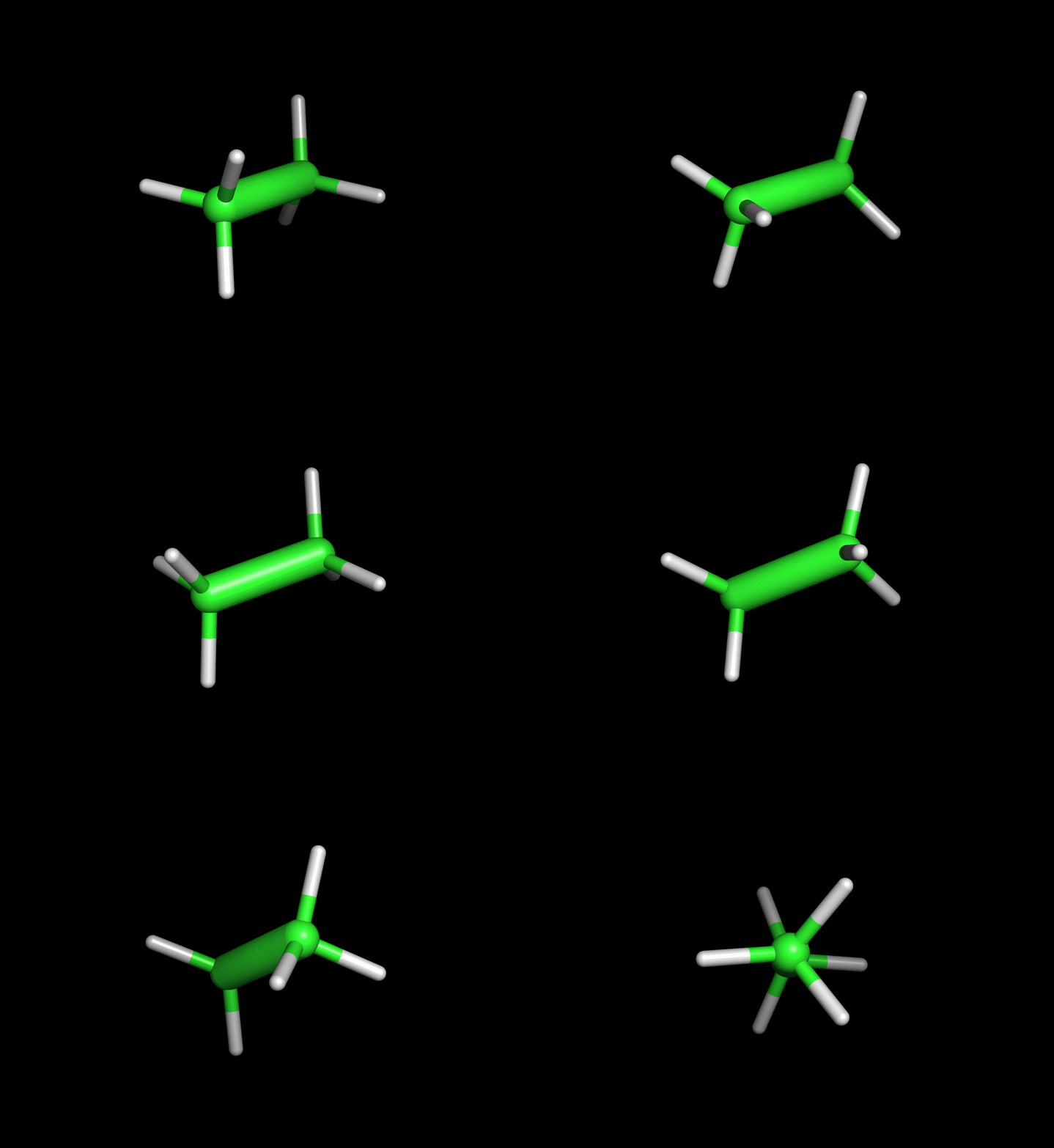
Out[26]:
<IPython.core.display.Image object>
In [27]:
Image(filename='vr.gif')
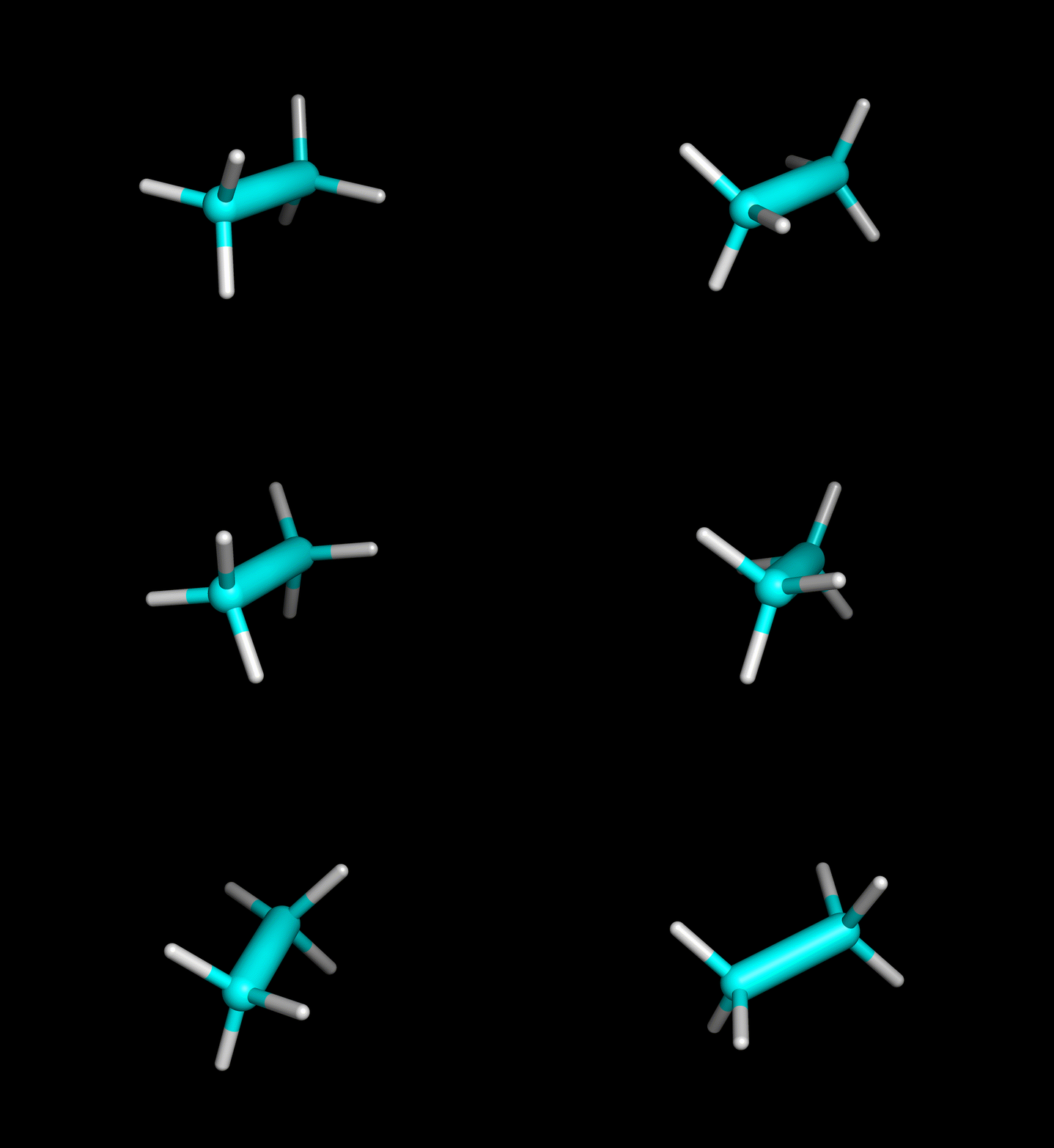
Out[27]:
<IPython.core.display.Image object>
In [28]:
Image(filename='nh.gif')
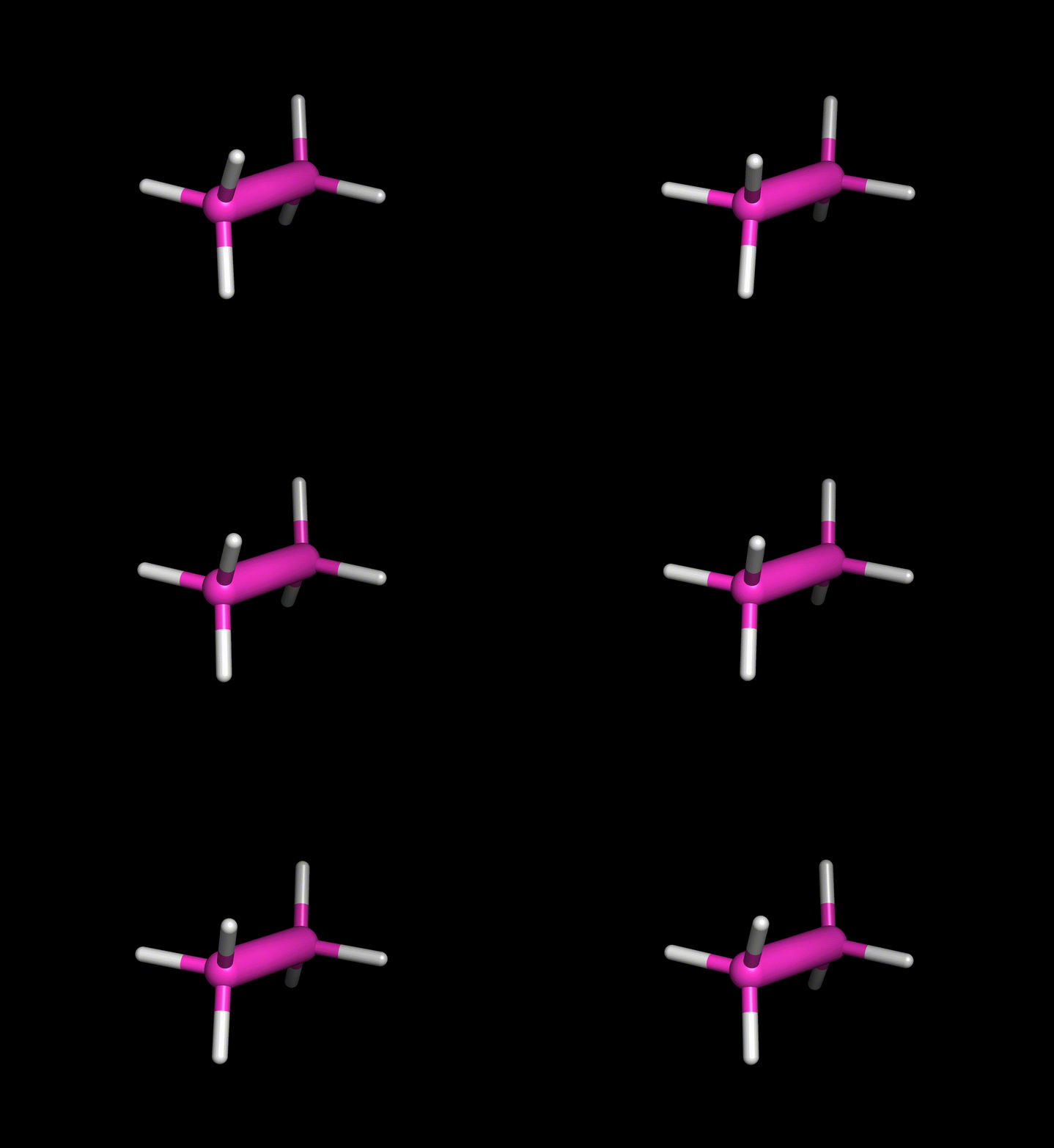
Out[28]:
<IPython.core.display.Image object>
In [29]:
Image(filename='sd.gif')
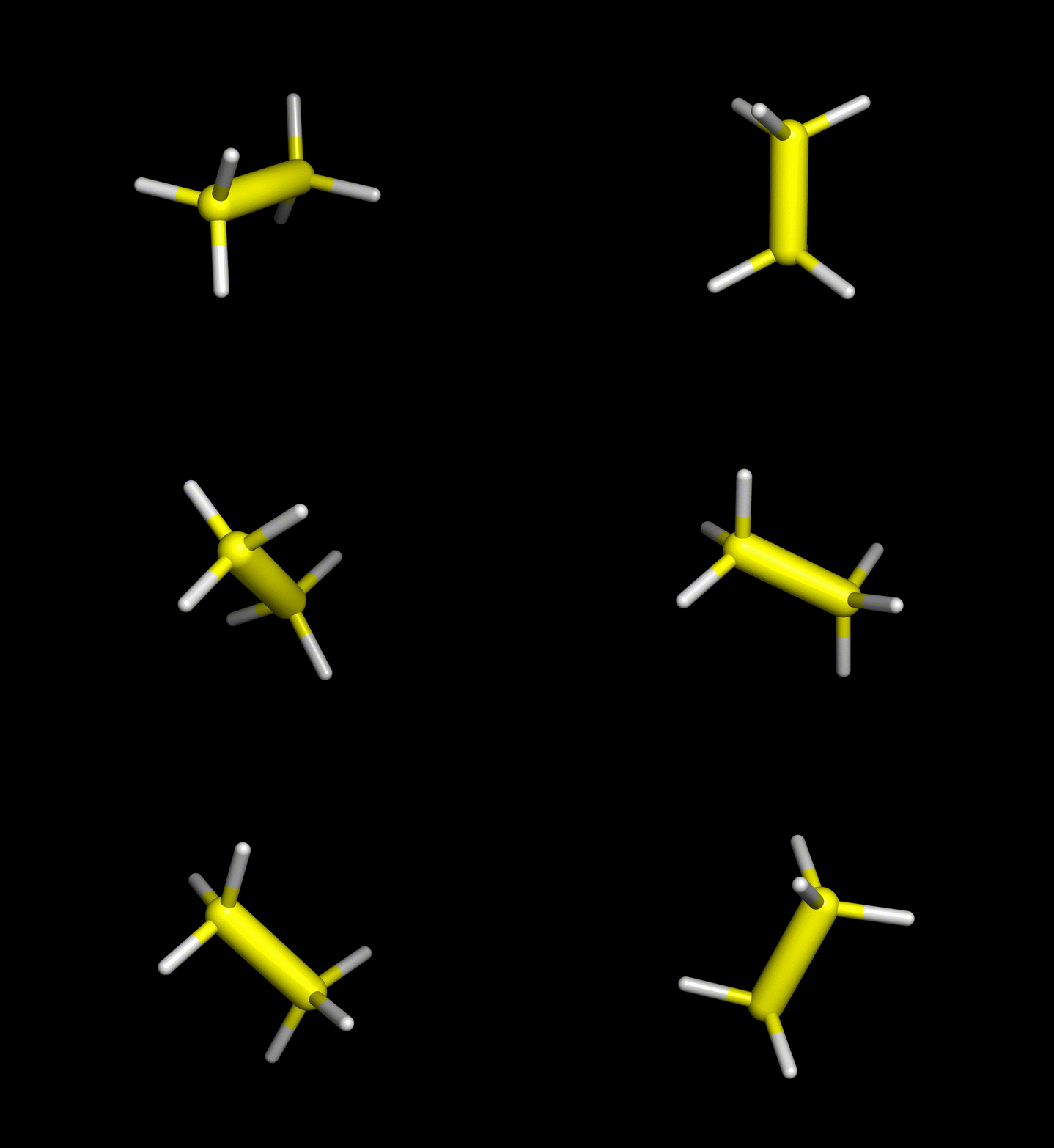
Out[29]:
<IPython.core.display.Image object>
In [16]:
#Сравним потенциальную энергию и кинетическую энергию для каждой из 4 систем.
In [19]:
l = ['be', 'vr', 'nh', 'sd']
for s in l:
 !echo "8 9 0" | gmx energy -f et_{s}.edr -o et_{s}_en.xvg -xvg none
              :-) GROMACS - gmx energy, 2022.5-Debian_2022.5_2 (-:

Executable:   /bin/gmx
Data prefix:  /usr
Working dir:  /home/students/y22/urazov.d/term8/Pr6
Command line:
  gmx energy -f et_be.edr -o et_be_en.xvg -xvg none

Opened et_be.edr as single precision energy file

Select the terms you want from the following list by
selecting either (part of) the name or the number or a combination.
End your selection with an empty line or a zero.
-------------------------------------------------------------------
  1  Bond             2  Angle            3  Ryckaert-Bell.   4  LJ-14
  5  Coulomb-14       6  LJ-(SR)          7  Coulomb-(SR)     8  Potential
  9  Kinetic-En.     10  Total-Energy    11  Conserved-En.   12  Temperature
 13  Pressure        14  Vir-XX          15  Vir-XY          16  Vir-XZ
 17  Vir-YX          18  Vir-YY          19  Vir-YZ          20  Vir-ZX
 21  Vir-ZY          22  Vir-ZZ          23  Pres-XX         24  Pres-XY
 25  Pres-XZ         26  Pres-YX         27  Pres-YY         28  Pres-YZ
 29  Pres-ZX         30  Pres-ZY         31  Pres-ZZ         32  #Surf*SurfTen
 33  T-System        34  Lamb-System


Back Off! I just backed up et_be_en.xvg to ./#et_be_en.xvg.1#
Last energy frame read 2500 time  250.000

Statistics over 250001 steps [ 0.0000 through 250.0000 ps ], 2 data sets
All statistics are over 2501 points (frames)

Energy                      Average   Err.Est.       RMSD  Tot-Drift
-------------------------------------------------------------------------------
Potential                   16.8354       0.12    1.63759   0.678422  (kJ/mol)
Kinetic En.                   26.06       0.05    1.59831   -0.22682  (kJ/mol)

GROMACS reminds you: "Time is the best appraiser of scientific work, and I am aware that an industrial discovery rarely produces all its fruit in the hands of its first inventor." (Louis Pasteur)

              :-) GROMACS - gmx energy, 2022.5-Debian_2022.5_2 (-:

Executable:   /bin/gmx
Data prefix:  /usr
Working dir:  /home/students/y22/urazov.d/term8/Pr6
Command line:
  gmx energy -f et_vr.edr -o et_vr_en.xvg -xvg none

Opened et_vr.edr as single precision energy file

Select the terms you want from the following list by
selecting either (part of) the name or the number or a combination.
End your selection with an empty line or a zero.
-------------------------------------------------------------------
  1  Bond             2  Angle            3  Ryckaert-Bell.   4  LJ-14
  5  Coulomb-14       6  LJ-(SR)          7  Coulomb-(SR)     8  Potential
  9  Kinetic-En.     10  Total-Energy    11  Conserved-En.   12  Temperature
 13  Pressure        14  Vir-XX          15  Vir-XY          16  Vir-XZ
 17  Vir-YX          18  Vir-YY          19  Vir-YZ          20  Vir-ZX
 21  Vir-ZY          22  Vir-ZZ          23  Pres-XX         24  Pres-XY
 25  Pres-XZ         26  Pres-YX         27  Pres-YY         28  Pres-YZ
 29  Pres-ZX         30  Pres-ZY         31  Pres-ZZ         32  #Surf*SurfTen
 33  T-System        34  Lamb-System


Back Off! I just backed up et_vr_en.xvg to ./#et_vr_en.xvg.1#
Last energy frame read 2500 time  250.000

Statistics over 250001 steps [ 0.0000 through 250.0000 ps ], 2 data sets
All statistics are over 2501 points (frames)

Energy                      Average   Err.Est.       RMSD  Tot-Drift
-------------------------------------------------------------------------------
Potential                   16.9514        0.4    8.70699    1.34038  (kJ/mol)
Kinetic En.                 26.8626       0.24    8.47283   0.971287  (kJ/mol)

GROMACS reminds you: "Time is the best appraiser of scientific work, and I am aware that an industrial discovery rarely produces all its fruit in the hands of its first inventor." (Louis Pasteur)

              :-) GROMACS - gmx energy, 2022.5-Debian_2022.5_2 (-:

Executable:   /bin/gmx
Data prefix:  /usr
Working dir:  /home/students/y22/urazov.d/term8/Pr6
Command line:
  gmx energy -f et_nh.edr -o et_nh_en.xvg -xvg none

Opened et_nh.edr as single precision energy file

Select the terms you want from the following list by
selecting either (part of) the name or the number or a combination.
End your selection with an empty line or a zero.
-------------------------------------------------------------------
  1  Bond             2  Angle            3  Ryckaert-Bell.   4  LJ-14
  5  Coulomb-14       6  LJ-(SR)          7  Coulomb-(SR)     8  Potential
  9  Kinetic-En.     10  Total-Energy    11  Conserved-En.   12  Temperature
 13  Pressure        14  Vir-XX          15  Vir-XY          16  Vir-XZ
 17  Vir-YX          18  Vir-YY          19  Vir-YZ          20  Vir-ZX
 21  Vir-ZY          22  Vir-ZZ          23  Pres-XX         24  Pres-XY
 25  Pres-XZ         26  Pres-YX         27  Pres-YY         28  Pres-YZ
 29  Pres-ZX         30  Pres-ZY         31  Pres-ZZ         32  #Surf*SurfTen
 33  T-System


Back Off! I just backed up et_nh_en.xvg to ./#et_nh_en.xvg.1#
Last energy frame read 2500 time  250.000

Statistics over 250001 steps [ 0.0000 through 250.0000 ps ], 2 data sets
All statistics are over 2501 points (frames)

Energy                      Average   Err.Est.       RMSD  Tot-Drift
-------------------------------------------------------------------------------
Potential                   25.8151        1.1    83.0321   -4.24394  (kJ/mol)
Kinetic En.                 32.3337       0.81    71.5938  -0.771759  (kJ/mol)

GROMACS reminds you: "Time is the best appraiser of scientific work, and I am aware that an industrial discovery rarely produces all its fruit in the hands of its first inventor." (Louis Pasteur)

              :-) GROMACS - gmx energy, 2022.5-Debian_2022.5_2 (-:

Executable:   /bin/gmx
Data prefix:  /usr
Working dir:  /home/students/y22/urazov.d/term8/Pr6
Command line:
  gmx energy -f et_sd.edr -o et_sd_en.xvg -xvg none

Opened et_sd.edr as single precision energy file

Select the terms you want from the following list by
selecting either (part of) the name or the number or a combination.
End your selection with an empty line or a zero.
-------------------------------------------------------------------
  1  Bond             2  Angle            3  Ryckaert-Bell.   4  LJ-14
  5  Coulomb-14       6  LJ-(SR)          7  Coulomb-(SR)     8  Potential
  9  Kinetic-En.     10  Total-Energy    11  Temperature     12  Pressure
 13  Vir-XX          14  Vir-XY          15  Vir-XZ          16  Vir-YX
 17  Vir-YY          18  Vir-YZ          19  Vir-ZX          20  Vir-ZY
 21  Vir-ZZ          22  Pres-XX         23  Pres-XY         24  Pres-XZ
 25  Pres-YX         26  Pres-YY         27  Pres-YZ         28  Pres-ZX
 29  Pres-ZY         30  Pres-ZZ         31  #Surf*SurfTen   32  T-System


Back Off! I just backed up et_sd_en.xvg to ./#et_sd_en.xvg.1#
Last energy frame read 2500 time  250.000

Statistics over 250001 steps [ 0.0000 through 250.0000 ps ], 2 data sets
All statistics are over 2501 points (frames)

Energy                      Average   Err.Est.       RMSD  Tot-Drift
-------------------------------------------------------------------------------
Potential                   13.0362       0.37    7.43987    1.57089  (kJ/mol)
Kinetic En.                 26.2428       0.22    7.80083   0.512805  (kJ/mol)

GROMACS reminds you: "Time is the best appraiser of scientific work, and I am aware that an industrial discovery rarely produces all its fruit in the hands of its first inventor." (Louis Pasteur)
In [20]:
#Постройте графики изменения энергий. Рекомендуемый вид это lines. Графики добавьте в отчёт. Удобно загружать данные с numpy.loadtxt
In [22]:
import numpy as np
import matplotlib.pyplot as plt
In [27]:
l = ['be', 'vr', 'nh', 'sd']
fig, axes = plt.subplots(2, 2, figsize=(12, 10))
axes = axes.flatten()
for i, s in enumerate(l):
    a = np.loadtxt(f'et_{s}_en.xvg')
    t = a[:, 0]
    pot = a[:, 1]
    kin = a[:, 2]
    axes[i].plot(t, pot, label='Потенциальная', color='blue')
    axes[i].plot(t, kin, label='Кинетическая', color='red', alpha=0.7)
    axes[i].set_title(f'Алгоритм: {s.upper()}')
    axes[i].set_xlabel('Время (пикосекунды)')
    axes[i].set_ylabel('Энергия (кДж/моль)')
    axes[i].legend()
    axes[i].grid(True)
plt.tight_layout()
plt.show()

In [1]:
#Рассмотрим распределение длинны связи С-С за время моделирования.
#Сначала создадим индекс файл с одной связью. Файл: b.ndx
#С содержимым:
#[ b ]
#1 2
In [2]:
#Запустим утилиту по анализу связей distance
In [6]:
l = ['be', 'vr', 'nh', 'sd']
for s in l:
 !echo 0 | gmx distance -f et_{s}.trr -s et_{s}.tpr -oh bond_{s}.xvg -n b.ndx -xvg none
             :-) GROMACS - gmx distance, 2022.5-Debian_2022.5_2 (-:

Executable:   /bin/gmx
Data prefix:  /usr
Working dir:  /home/students/y22/urazov.d/term8/Pr6
Command line:
  gmx distance -f et_be.trr -s et_be.tpr -oh bond_be.xvg -n b.ndx -xvg none

Reading file et_be.tpr, VERSION 2022.5-Debian_2022.5_2 (single precision)
Reading file et_be.tpr, VERSION 2022.5-Debian_2022.5_2 (single precision)
trr version: GMX_trn_file (single precision)
Reading frame     200 time  200.000
Analyzed 251 frames, last time 250.000
b:
  Number of samples:  251
  Average distance:   0.15316  nm
  Standard deviation: 0.00170  nm

GROMACS reminds you: "An expert is a person who has made all the mistakes that can be made in a very narrow field." (Niels Bohr)

             :-) GROMACS - gmx distance, 2022.5-Debian_2022.5_2 (-:

Executable:   /bin/gmx
Data prefix:  /usr
Working dir:  /home/students/y22/urazov.d/term8/Pr6
Command line:
  gmx distance -f et_vr.trr -s et_vr.tpr -oh bond_vr.xvg -n b.ndx -xvg none

Reading file et_vr.tpr, VERSION 2022.5-Debian_2022.5_2 (single precision)
Reading file et_vr.tpr, VERSION 2022.5-Debian_2022.5_2 (single precision)
trr version: GMX_trn_file (single precision)
Reading frame     200 time  200.000
Analyzed 251 frames, last time 250.000
b:
  Number of samples:  251
  Average distance:   0.15336  nm
  Standard deviation: 0.00378  nm

GROMACS reminds you: "An expert is a person who has made all the mistakes that can be made in a very narrow field." (Niels Bohr)

             :-) GROMACS - gmx distance, 2022.5-Debian_2022.5_2 (-:

Executable:   /bin/gmx
Data prefix:  /usr
Working dir:  /home/students/y22/urazov.d/term8/Pr6
Command line:
  gmx distance -f et_nh.trr -s et_nh.tpr -oh bond_nh.xvg -n b.ndx -xvg none

Reading file et_nh.tpr, VERSION 2022.5-Debian_2022.5_2 (single precision)
Reading file et_nh.tpr, VERSION 2022.5-Debian_2022.5_2 (single precision)
trr version: GMX_trn_file (single precision)
Reading frame     200 time  200.000
Analyzed 251 frames, last time 250.000
b:
  Number of samples:  251
  Average distance:   0.14812  nm
  Standard deviation: 0.00697  nm

GROMACS reminds you: "An expert is a person who has made all the mistakes that can be made in a very narrow field." (Niels Bohr)

             :-) GROMACS - gmx distance, 2022.5-Debian_2022.5_2 (-:

Executable:   /bin/gmx
Data prefix:  /usr
Working dir:  /home/students/y22/urazov.d/term8/Pr6
Command line:
  gmx distance -f et_sd.trr -s et_sd.tpr -oh bond_sd.xvg -n b.ndx -xvg none

Reading file et_sd.tpr, VERSION 2022.5-Debian_2022.5_2 (single precision)
Reading file et_sd.tpr, VERSION 2022.5-Debian_2022.5_2 (single precision)
trr version: GMX_trn_file (single precision)
Reading frame     200 time  200.000
Analyzed 251 frames, last time 250.000
b:
  Number of samples:  251
  Average distance:   0.15263  nm
  Standard deviation: 0.00331  nm

GROMACS reminds you: "An expert is a person who has made all the mistakes that can be made in a very narrow field." (Niels Bohr)
In [8]:
#Построим гистограммы распределения длинн связей
In [9]:
import pandas as pd
import matplotlib.pyplot as plt
In [14]:
def hist(filename):
    data = pd.read_csv(filename, sep='\s+', comment='@', header=None, names=['Time', 'Distance'])
    plt.figure(figsize=(8, 5))
    plt.hist(data['Distance'], bins=50, color='skyblue', edgecolor='black', alpha=0.7)
    plt.title(f'Распределение расстояний: {filename}')
    plt.xlabel('Расстояние (нм)')
    plt.ylabel('Частота')
    plt.grid(axis='y', linestyle='--', alpha=0.7)
    plt.show()
In [16]:
hist('bond_be.xvg')

In [18]:
hist('bond_vr.xvg')

In [15]:
hist('bond_nh.xvg')

In [19]:
hist('bond_sd.xvg')

In [24]:
#Из полученные результатов видно, что алгоритмы различаются дисперсией расстояний между C-C.
#У be (термостат Берендсена) - очень большая дисперсия
# vr (Velocity Rescaling) - плохо соотносится с распределением Больцмана
# nh (термостат Нозе-Гувера) - хороший алгоритм, малая дисперсия, лучше соотносится с распределением Больцмана
# sd (стохастическая динамика) - из-за симулированных постоянных толчков sd может не подходить для некоторых задач, но идеально подходит для молекулярной динамики в растворителе
#Таблица зависимости быстродействия от алгоритма:
# Алгоритм    Быстродействие(ns/day)
#       be    7889.160
#       vr    8104.661
#       nh    8052.763
#       sd    7871.285
In [ ]: